

Our product picks are editor-tested, expert-approved. We may earn a commission through links on our site. Why Trust Us?
What do French fries, ice cream, and pancakes all have in common? You can have them all on an intermittent fasting diet.
The intermittent fasting (also referred to simply as IF) diet plan shifts the focus from what you eat to the timeframe in which you eat. That means any delicious food you want, as long as it’s within a small window. The concept is thought to promote better digestion, stave off late-night snacking, and facilitate weight loss. Let’s be clear, though: while this approach does allow for more flexibility in the foods you consume than other diet plans, you probably shouldn’t subsist on only French fries, ice cream, and pancakes.
“Recent 2023 research has shown IF to be equal, if not superior, to calorie counting for weight loss, especially in people with obesity or type 2 diabetes,” says Kelsey Costa, R.D.N., nutrition consultant for the National Coalition on Healthcare. This can be attributed to its direct effects on the body's metabolic processes, ability to improve insulin sensitivity and blood sugar control, and potential to positively alter the gut microbiome and brain activity.
For many, the concept of alternating periods of eating with periods of fasting is more appealing than a traditional diet. “Even when matching the weight loss and health outcomes of calorie restriction in controlled settings, in practice, IF is arguably easier to maintain long-term as it allows for flexibility and does not require constant calorie tracking,” says Kristin Kirkpatrick, R.D., at the Cleveland Clinic.
If you tend to backload your calories late in the day, intermittent fasting might be a solid option for you, says Leslie Bonci, R.D.N., M.P.H., sports dietician for the Kansas City Chiefs. It may even help improve your digestion and sleep, because eating too close to bedtime can disrupt the body's recovery mode.
IF isn’t for everyone, though. Depending on the particular IF eating plan (of which there are several; more on that below), those who struggle with eating on a strict schedule may not be suited for IF, says Costa. “Furthermore, people with medical conditions should consult their healthcare provider before starting IF to ensure it is safe, adjust their medication, and monitor for any adverse effects.”
With those important guidelines in mind, if you're great at sticking to a schedule, and you're looking to slim down, intermittent fasting might be the plan for you. But then comes the big question: How do you pick a schedule that's right for you?
There are a handful of intermittent fasting eating schedules, and deciding which is best for you can be tough. The biggest thing is figuring out a schedule that feels sustainable. Below, everything you need to know about the different intermittent fasting schedules.
What Is Intermittent Fasting?
Intermittent fasting is the increasingly popular way to limit caloric intake by limiting the amount of time you allow yourself to eat.
The idea stems from our hunter-gatherer roots. It's thought that our bodies are much more adapted to fasting than we are to our esteemed three meals a day. The theory suggests that our ancestors fasted often when food was scarce, causing our cells to learn how to function in a fasted-state, according to a 2019 study published in the New England Journal of Medicine.
And thus, intermittent fasting was born. Though research has shown improvements in insulin resistance, blood pressure levels, and and inflammation, intermittent fasting is famed for its potential effects on weight loss. It has been seen to help people lose 7 to 11 pounds on average over 10 weeks, according to the Harvard School of Public Health.
By no means is it a perfect weight loss solution, though. The issue is that there may be a plateau in this weight loss eventually, says Perri Halperin, M.S., R.D., clinical nutrition coordinator at Mount Sinai Health System. The body may go into starvation mode, which will cause it to hold onto fat stores in preparation for another round of fasting. "So, it becomes harder to lose weight at a certain point, even though at first the weight will come down."
Even then, it might be worth giving it a shot if it feels like a sustainable plan for you, or if you're looking to shed only a few pounds. It might even be a way to simply kick the habit of midnight snacking. Whatever your goal, finding a schedule that you can stick with makes all the difference.
How do I Pick the Best Intermittent Fasting Schedule?
Ultimately, the best diet is the one you are most likely to stick with. The schedules that more closely resemble your normal eating patterns are going to be the easiest ones to adhere to, Halperin says. Not eating late at night is key, since "you want to give your body the chance to rest and repair, versus putting it in more of an action state," she says.
A few different intermittent fasting schedule options, below.
What Are Different Intermittent Fasting Schedules?
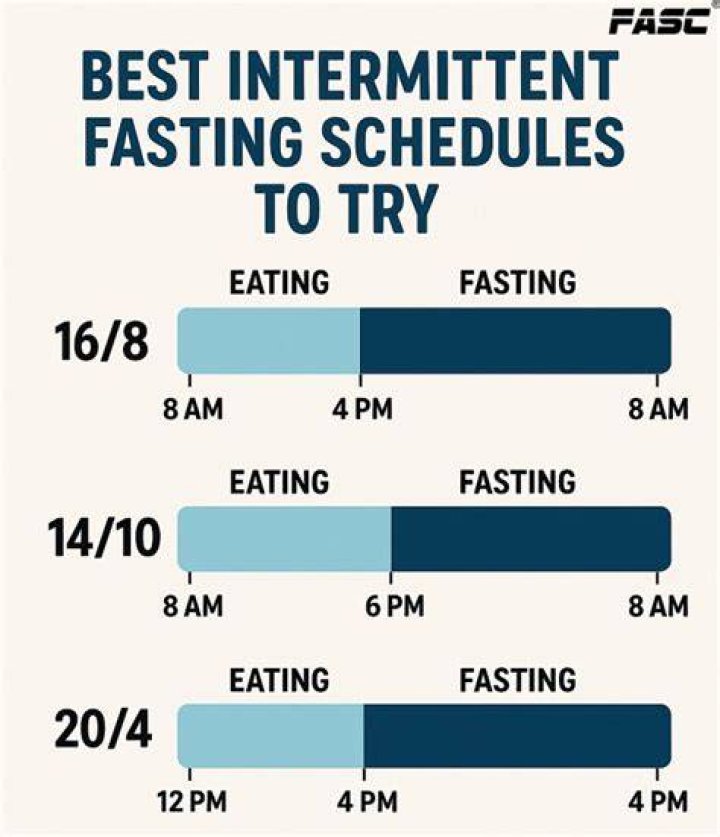
The 16:8 Schedule
The 16:8 schedules is the most common of all the intermittent fasting schedules. It most closely mimics our traditional eating style, making it more sustainable, Halperin says.
The idea is you get to eat 8 hours of the day, and fast for 16. The benefit of this schedule is you get to pick when to start and stop your fast. So, if you're most hungry in the mornings, you can start your eating window right when you wake up. If you don't typically get hungry until lunch time, you can start your window at noon and stop eating at 8 p.m.
It's proven too—the 16:8 schedule, in conjunction with resistance training, has shown to improve several health markers and decreased fat in men.
The 14:10 Schedule
This approach is similar to the 16:8, just with a bigger eating window. A bigger window doesn't necessarily mean you won't lose weight, though.
A 2021 study found that a group of people with obesity lost significant weight sticking to a 14 hour fast when paired with a diet program.
Whole Day Fasting Schedule
Otherwise known as the 5:2 intermittent fasting schedule, this takes fasting to more of an extreme than the schedules above. The goal here is to eat a normal amount 5 days out of the week, and then cut your intake to 20 percent of your intake for 2 of the days. That's about 600 calories for men.
When this program was studied in 2021, there were solid effects on weight loss, but the program had less than stellar adherence. After 6 months, only 31 percent of those who were participating in the study kept up with the schedule. Again, the best diet is one that you can stick to—so if extremes like this aren't in your wheelhouse, it's better to choose one that is.
Alternate Fasting Schedule
This is another higher-stakes intermittent fasting schedule. As the name hints, this plan will have you fully fasting every other day. When studied in comparison with regular calorie-restriction dieting, the alternating fasting schedule didn't show significantly better weight loss results. So, unless you succeed in an all or nothing environment, this might not be the best option for you.
If you're struggling to find a diet plan that works for you, it's never a bad idea to have a conversation with your doctor or a certified dietician. Together, you can come up with a plan that will be more tailored to you.
Fasting Mimicking Diet
Also referred to as FMD, this eating regime is another form of intermittent fasting specific to prolonged fasting. This program aims to replicate the effects of fasting while still allowing some food intake. People following the plan consume a low-calorie, low-carb, low-protein diet for a time-frame of four-to-seven days, ideally on a monthly basis. After that five-day or so meal plan, you resume your regular diet for the rest of the month.
Limited research shows FMD’s effectiveness in longevity, skin and hydration, belly fat reduction, cognitive health, and diabetes, says Kirkpatrick. While more research is necessary, FMD “holds promise for improving cognitive function in [Alzheimer’s Disease],” according to research published in 2023 in Biomolecules. Per Kirkpatrick, FMD “may be a great addition to other fasting methods since the approach is only five days for each cycle.”